The Biggest Vision Yet: T.W.A. Airlines Is in the Making
- Mr. John Washington

- 2 hours ago
- 2 min read
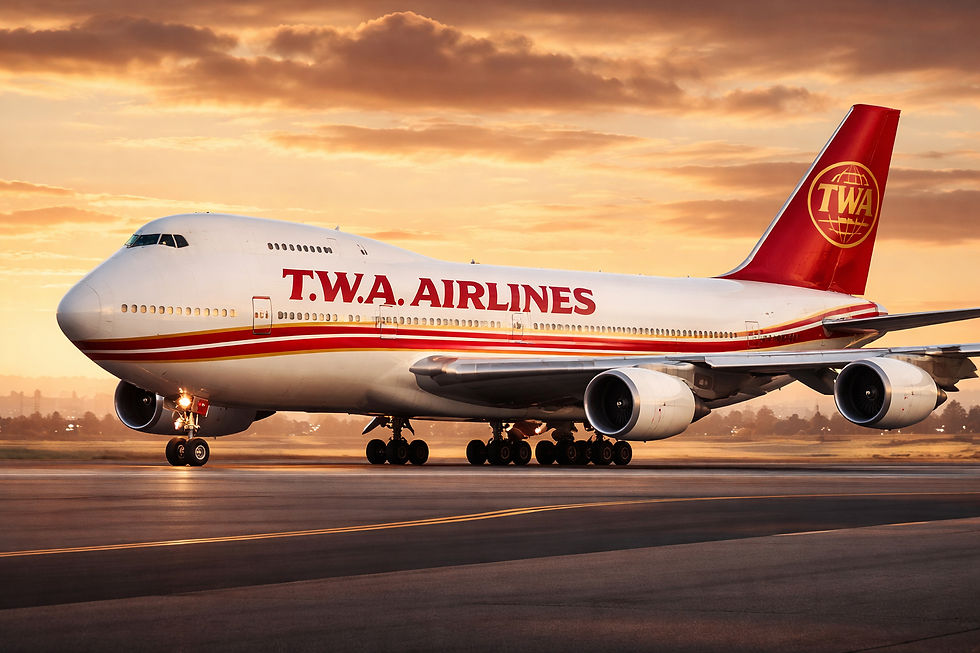
Every transformative movement reaches a defining milestone — a project so ambitious that it shifts perception from “idea” to “industry force.”
For Mr. Washington, that milestone is now in development: the creation of T.W.A. Airlines.
This is not a symbolic venture. It is a structural play aimed directly at the heart of the American aviation market.
The Core Strategy: Price Disruption at Scale
The proposed model is straightforward and aggressive:
$100 one-way flights
$200 round-trip flights
Service concentrated on the 15 largest air travel hubs in the United States
Target markets would include major cities such as:
New York City
Washington, D.C.
Miami
Chicago
Los Angeles
These hubs represent some of the highest passenger traffic corridors in North America. Instead of scattering routes across low-demand markets, the focus is density, frequency, and volume within proven air travel corridors.
How Price Disruption Creates Market Control
The airline industry operates on volume, load factor, route optimization, and cost efficiency.
If T.W.A. Airlines successfully offers significantly lower pricing on high-demand routes, the competitive impact is immediate:
Increased passenger acquisition
Rapid brand visibility
Market share pressure on legacy carriers
High-frequency repeat customers
Air travel is not a niche market — it is a trillion-dollar global industry. Capturing even a fraction of the domestic high-density routes represents substantial revenue potential.
Why This Is Bigger Than Flights
For members of the T.W.A. Millionaires Club, this venture is not just about affordable travel — it represents strategic positioning inside one of the most powerful industries in the world.
Airlines generate revenue beyond ticket sales:
Baggage fees
Seat upgrades
Loyalty programs
Strategic partnerships
Cargo logistics
In-flight sales
Co-branded credit programs
When scaled correctly, aviation is not simply transportation — it is a multi-channel revenue engine.
The Compounding Effect on Wealth
Here is where the broader economic vision connects.
If T.W.A. Airlines captures substantial passenger volume across major hubs:
Revenue increases through scale
Brand leverage expands into tourism, hospitality, and corporate travel
Integrated partnerships grow across other Washington portfolio businesses
Cross-industry synergy compounds growth
High-volume, low-margin models — when executed with operational discipline — can outperform high-margin, low-volume competitors over time.
Dominate traffic.
Control routes.
Build loyalty.
Expand vertically.
That is the structural blueprint.
The Psychological Shift
Affordable flights at $100 one way would not simply attract budget travelers. It would reshape consumer expectations. Price leadership in major corridors creates behavioral momentum.
Once travelers experience consistent affordability on key routes, switching costs increase. Habit forms. Brand familiarity strengthens.
Market dominance begins with attention — but it is sustained by reliability and volume.
The Larger Vision

T.W.A. Airlines represents scale. It represents infrastructure. It represents stepping into an industry traditionally controlled by legacy players and challenging it through pricing discipline and strategic concentration.
For the T.W.A. Millionaires Club, this is positioned as more than a company launch. It is a defining moment in portfolio expansion — a venture designed to influence one of the most powerful economic sectors in the country.
The work is in motion.
The strategy is bold.
And the ambition is clear: build an enterprise capable of reshaping domestic air travel economics.


Comments